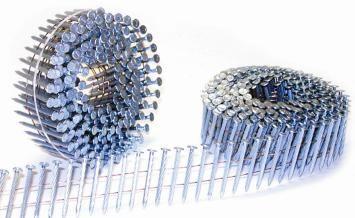
Collated nails are offered in a variety of degrees, sizes, and types. This article will take you step by step in determining the classification, range, type, and finish required for your application. A popular choice, check out Nail Gun Depot's SureFit nails, if you are looking for a high-quality fastener at a fraction of the cost. Another popular choice, Senco Nails offers a wide variety of fasteners to choose from, with genuine, time-tested durability.
The first step is to determine what collation angle your tool is designed to run. Some degrees include 20 °, 35 °, 28 ° and 15 °. The next step would be to classify what types of collation the tool handles. Collations include plastic, wire, and paper - which can be used in place of plastic.
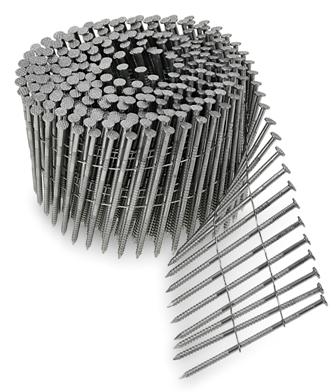
When you have completed the nail classification, you will then determine the tool range. The length and diameter are known as the range. Length is the size of the nail, each tool will have a minimum and maximum length. Note: some nails are sized in pennies (symbol, D). Diameter is the thickness of the shank or wire gauge. The bigger the number, the thicker the nail.
The type of nail can be broken into three categories; head, point, and shank. Head types include duplex, headless, finish, drywall, clipped, and full round which is the most common. The type of point determines how the nail will penetrate your application and the splitting severity. The most common is the chisel (diamond) point and the easiest to drive. It is ideal for softwood applications. The blunt point allows minimal penetration resistance and is commonly used in pallet construction. Flat point, also known as chisel point, requires the most drive power and is frequently used with a screw shank nail.
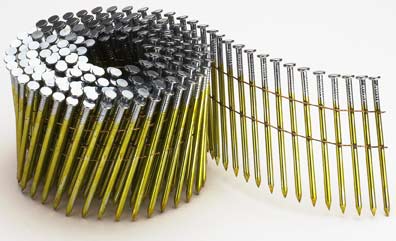
The nail shank is the part on the nail which does most of the holding. The shank is one of four types: smooth, spiral, ring or screw. Smooth shank nails have exactly that: a smooth appearance and have the least holding power. Spiral shank nails have either a threaded appearance, like a screw, or they can have a helical twist to them. Screw shank nails are used in hardwood applications. Ring shank nails have a series of rings punched into the surface of the shank and offer the most holding power.
The nail finish can be bright, cement-coated, electro-galvanized, hot dipped galvanized, flash-coated with zinc, hardened steel, stainless steel, or aluminum. These different finishes, coatings, or materials of nails give different levels of protection of resistance to rusting or other special properties to certain applications.