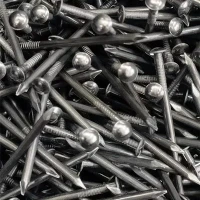
Coil nail oil, this is the root of all the problems we do this industry coil nail manufacturers, here we say the oil is not real oil, but a rust oil, it is inherent in a significant feature is that this oil and other types of oil is very different. The pigment particles contained in the oil must be small. In addition, due to the thin thickness of the ink film coated by the nail, the pigment concentration in the oil coated by the nail must be high enough in order to obtain sufficient covering power.
Steps and points of attention for nail oiling
Step, add ink, this marks the beginning of the roll nail oiling. Some machines use open oil cartridges, while others use closed ones. At this time, the oil viscosity must be low enough that the ink can be evenly spread on the surface of the nail and can enter the dented thread.
The second step is to get the ink into the etched concave area. Due to the rapid evaporation of the solvent, this will cause the oil on the surface of the image depression to be a little stickier than the oil below.
Step three, squeeze the air out of the nail.
Step four: Suck up the excess oil.
The fifth step is to dry the oil after it leaves the surface of the adsorbent. In this step, air can be prevented from remaining between the oil and the coil nail, as this will cause uneven oiling.
Step six, roll it up into a finished product.
If the variation factors involved in these six steps can be properly controlled, we will have a very beautiful curling nail.
From the above six steps, it can be seen that since the requirements for viscosity change are very high, the solvent used in the oil is volatilized much faster than the ordinary solvent, which is very important for the formula of the oil. These details can be ignored by every roll nail manufacturer, but they must attract everyone's attention.