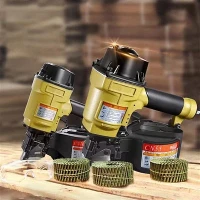
As an important fastening tool in modern building decoration and industrial manufacturing, air nail guns are widely popular for their high efficiency and stable performance. Different types of air nail guns are suitable for different working environments and needs. Only when suppliers accurately understand the classification system of air nail guns can they provide customers with the most suitable products and improve service quality and market competitiveness.
Classification by nail type
Air nail guns can be mainly divided into three categories: straight nail guns, coil nail guns and frame nail guns according to the different nail types used.
Straight nail gun: using nail strips arranged in a straight line, the nails are arranged neatly, suitable for a variety of general carpentry and decoration operations. The structure of the straight nail gun is relatively simple, easy to maintain, and suitable for scenes with high requirements for nail type compatibility.
Roll nail gun: using nails supplied in the form of coils, the nails are arranged in a curved manner, the number is large, and the continuous nailing efficiency is higher. Coil nail guns are mostly used in industrial production lines and large-scale decoration projects that require a large number of fast nails, reducing the downtime of frequent nailing.
Frame nail gun: a nail gun specially used for installing frame structures. The nails are usually long and arranged at a specific angle. They are suitable for heavy wood structures or building frame connections, providing stronger fixing force and bearing capacity.
Classification by use
According to different application fields, air nail guns are usually divided into three categories: decoration, carpentry and industrial.
Decoration air nail gun: emphasizes portability and light operation, suitable for indoor decoration work such as wall decoration, furniture installation, floor laying, etc. Usually the power is moderate to meet daily decoration needs.
Carpentry air nail gun: specially designed for furniture manufacturing and wood processing, requiring precise nailing and material-friendly to avoid wood cracking. Carpentry air nail guns are often equipped with a variety of nail types to meet different carpentry subdivision processes.
Industrial air nail gun: suitable for high-intensity, large-volume industrial production environments, such as shipbuilding, automotive interiors, packaging box manufacturing, etc. This type of nail gun is usually powerful, durable, and supports long-term continuous operation.
Classification by air pressure requirements
Air nail guns can also be classified according to the air pressure range required for work. Different air pressures correspond to different work intensities and material adaptability.
Low-pressure air nail guns: The working air pressure is generally 60-90 PSI, which is suitable for lightweight materials and fine work, reducing the impact on the material.
Medium-pressure air nail guns: The working air pressure is usually 90-120 PSI, which is widely used. It can not only cope with general decoration and carpentry, but also be competent for some industrial operations.
High-pressure air nail guns: The working air pressure can reach more than 120 PSI, which is suitable for fixing hard materials and heavy structures to ensure the depth and firmness of nailing.
When recommending products, suppliers should reasonably match the air pressure level according to the hardness of the customer's work materials, the work intensity and the situation of the on-site air compressor to ensure safe use and the best effect.
Conclusion
Understanding the multi-dimensional classification of air nail guns will help suppliers to more accurately understand customer needs and application scenarios and provide more targeted product solutions. Whether it is the flexibility and versatility of a straight nail gun, the high speed and efficiency of a coil nail gun, or the high-strength fixation of a frame nail gun; whether it is the different positioning for decoration, carpentry or industrial use, or the performance parameters adapted to different air pressures, reasonable matching is the key to improving customer satisfaction and market competitiveness.