

When it comes to construction and carpentry, ring shank coil nails are a staple in the toolkit of professionals and DIY enthusiasts alike. As a trusted supplier of ring shank coil nails, I often get asked about the bending strength of these essential fasteners. In this blog post, I'll delve into what bending strength means for ring shank coil nails, why it matters, and how it impacts your projects.
Understanding Bending Strength
Bending strength refers to the ability of a nail to resist deformation when subjected to a bending force. In the context of ring shank coil nails, this characteristic is crucial as it determines how well the nail can maintain its shape and integrity during installation and throughout the lifespan of the project. A nail with high bending strength is less likely to bend or break under pressure, ensuring a secure and long - lasting connection.
Several factors contribute to the bending strength of ring shank coil nails. The first is the material from which the nails are made. Most ring shank coil nails are crafted from high - quality steel, which offers excellent strength and durability. The grade of steel can vary, and higher - grade steels generally provide greater bending strength. For instance, nails made from hardened steel are more resistant to bending compared to those made from softer steel alloys.
The diameter of the nail also plays a significant role. Thicker nails typically have higher bending strength because they have more material to resist the applied force. A nail with a larger diameter can distribute the bending stress over a greater cross - sectional area, reducing the likelihood of failure.
The manufacturing process is another important factor. Precision manufacturing techniques ensure that the nails are formed with consistent dimensions and a uniform structure. This uniformity contributes to the overall strength of the nail. For example, nails that are properly heat - treated during the manufacturing process can achieve optimal hardness and toughness, enhancing their bending strength.
Why Bending Strength Matters in Ring Shank Coil Nails
In construction and carpentry, the bending strength of ring shank coil nails has far - reaching implications. When installing these nails, they are often driven into hard materials such as wood, concrete, or metal. If a nail has low bending strength, it may bend upon impact, making it difficult to drive in properly. This can lead to a poor connection between the materials being joined, compromising the structural integrity of the project.
For example, in pallet construction, Ring Shank 2 1/4''x.099'' Wire Pallet Coil Nails need to withstand significant forces during handling and transportation. A nail that bends easily may cause the pallet to come apart, resulting in damage to the goods being transported. Similarly, in siding installation, the bending strength of nails is essential to ensure that the siding panels remain securely attached to the building structure. Yellow Coated Coil Siding Nails with high bending strength can withstand the wind and weather forces that act on the siding over time.
In addition, in projects where the nails are subject to continuous vibration or movement, such as in machinery or furniture construction, a nail with high bending strength is crucial. The constant movement can cause nails with low bending strength to loosen or break, leading to a loss of stability in the structure.
Measuring Bending Strength
Measuring the bending strength of ring shank coil nails is a complex process that typically involves specialized testing equipment. One common method is the three - point bending test. In this test, a nail is placed on two supports, and a load is applied at the center of the nail. The force required to bend the nail to a certain degree is measured, and this value is used to determine the bending strength.
Another approach is the four - point bending test, which distributes the load over a larger area of the nail. This test provides a more accurate representation of the nail's performance under real - world conditions, as it simulates the way the nail is loaded in a structure.
Manufacturers often conduct these tests during the quality control process to ensure that their nails meet industry standards. For example, in the United States, nails must meet the standards set by the American Society for Testing and Materials (ASTM). These standards specify the minimum bending strength requirements for different types of nails, including ring shank coil nails.
Applications and the Role of Bending Strength
The high bending strength of ring shank coil nails makes them suitable for a wide range of applications. In the construction of wooden structures such as houses, barns, and decks, ring shank coil nails are used to join framing members, sheathing, and siding. The strong connection provided by these nails helps to resist the forces exerted by wind, seismic activity, and normal wear and tear.
In the manufacturing of furniture, ring shank coil nails are used to assemble frames and attach various components. The high bending strength ensures that the furniture remains sturdy and durable, even with regular use. For example, in the assembly of wooden chairs or tables, nails with high bending strength prevent the joints from coming apart, maintaining the structural integrity of the piece.
In the packaging industry, ring shank coil nails are used to construct pallets and crates. As mentioned earlier, the bending strength of these nails is critical to ensure that the pallets can withstand the rigors of handling, stacking, and transportation. 2.1x32mm/2.1x38mm Conical (dome) Ring Shank Wire Coil Nails are commonly used in this application due to their combination of strength and the ability to be easily driven into wood.
Our Offerings as a Ring Shank Coil Nails Supplier
As a supplier of ring shank coil nails, we take pride in offering products with exceptional bending strength. Our nails are made from high - grade steel, and we use state - of - the - art manufacturing processes to ensure consistent quality. We offer a wide range of nail sizes and diameters to meet the diverse needs of our customers.
Whether you are a professional contractor working on a large - scale construction project or a DIY enthusiast building a small piece of furniture, our ring shank coil nails are designed to provide reliable performance. Our Ring Shank 2 1/4''x.099'' Wire Pallet Coil Nails are ideal for heavy - duty pallet construction, while our 2.1x32mm/2.1x38mm Conical (dome) Ring Shank Wire Coil Nails are perfect for more delicate carpentry work. Our Yellow Coated Coil Siding Nails offer both high bending strength and corrosion resistance, making them suitable for exterior siding applications.
Conclusion and Call to Action
In conclusion, the bending strength of ring shank coil nails is a critical factor that determines their performance and suitability for various applications. High - quality materials, appropriate diameters, and precision manufacturing processes all contribute to a nail's ability to resist bending and provide a secure connection.

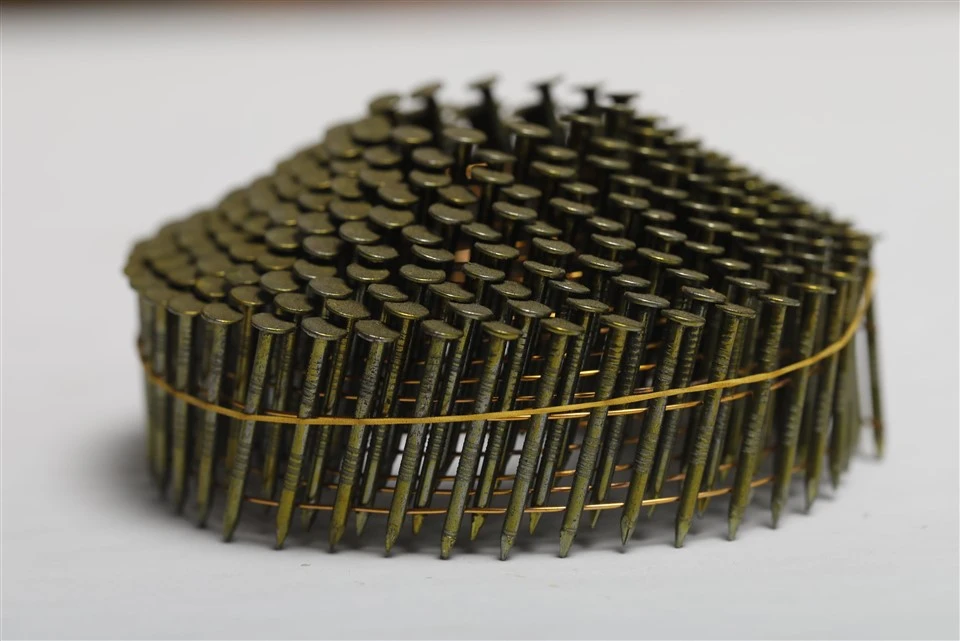
If you are in the market for ring shank coil nails, we invite you to explore our product range. Our commitment to quality and customer satisfaction ensures that you will receive nails that meet or exceed your expectations. Whether you have questions about the bending strength of our nails or need advice on the right product for your project, our team of experts is here to assist you. Contact us to discuss your requirements and start a procurement conversation today.
References
- American Society for Testing and Materials (ASTM) standards for nails.
- Engineering materials textbooks on the properties of steel and fasteners.
- Industry research on the performance of ring shank coil nails in different applications.