

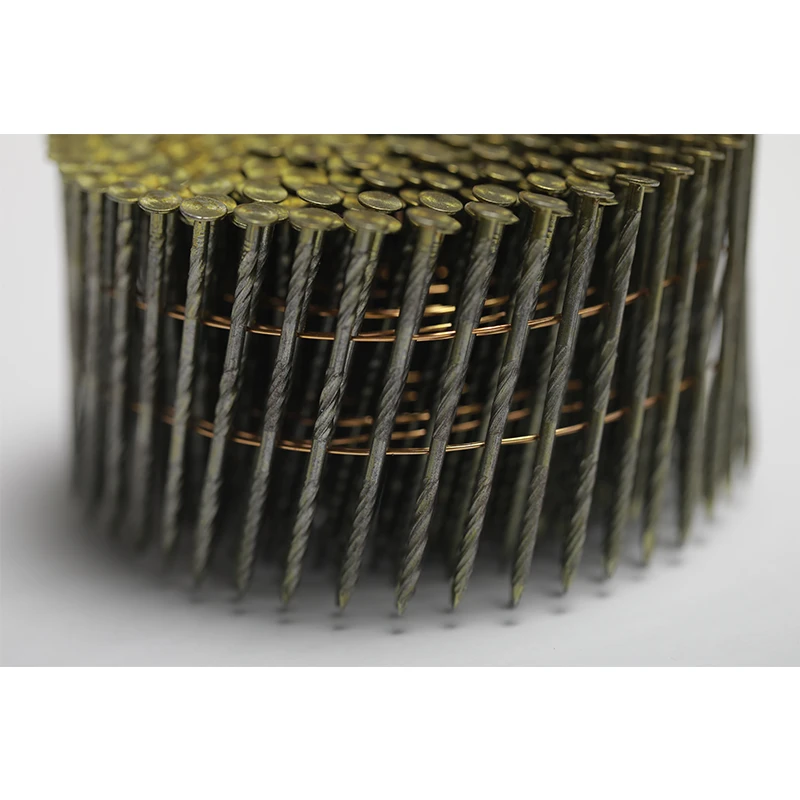
As a supplier of Screw Shank Coil Nails, I've had the privilege of witnessing the diverse applications of our products across various wood types. Screw shank coil nails are renowned for their superior holding power, making them a popular choice in construction and woodworking projects. But the question remains: what type of wood are screw shank coil nails best for? In this blog, we'll explore the characteristics of different wood types and how they interact with screw shank coil nails.
Softwoods
Softwoods are a common choice in construction due to their affordability, availability, and ease of use. They are typically sourced from coniferous trees such as pine, spruce, and fir. These woods have a relatively low density and are softer compared to hardwoods, which means they are more prone to splitting. However, this also makes them an ideal candidate for screw shank coil nails.
The screw shank design of these nails allows them to grip the softwood fibers effectively, providing excellent holding power. The threads on the nail shank act like a screw, pulling the nail into the wood and creating a tight bond. This is particularly useful in applications where the joint needs to withstand significant stress, such as framing and decking.
For example, pine is a popular softwood used in framing because of its strength and durability. Screw shank coil nails can be used to secure the pine framing members together, ensuring a stable and long-lasting structure. Similarly, spruce is often used in decking, and screw shank coil nails can help prevent the boards from loosening over time.
If you're working with softwoods, our 2.5mmx57mm Screw Shank Coil Nails are an excellent choice. They are designed to penetrate softwood easily and provide a strong hold.
Hardwoods
Hardwoods, on the other hand, are sourced from deciduous trees such as oak, maple, and cherry. These woods are known for their density, strength, and durability. They are often used in high-end furniture, flooring, and cabinetry.
While hardwoods are more resistant to splitting than softwoods, they can be more challenging to nail. The dense fibers of hardwoods require a nail with a strong shank and a sharp point to penetrate effectively. Screw shank coil nails are well-suited for this task.
The screw threads on the nail shank help to reduce the risk of splitting by gradually pulling the nail into the wood. This is especially important when working with hardwoods, as splitting can weaken the joint and compromise the integrity of the project.
For instance, oak is a popular hardwood used in furniture making. Screw shank coil nails can be used to assemble the oak components, providing a strong and secure joint. Maple is another hardwood commonly used in flooring, and screw shank coil nails can help ensure a tight and stable installation.
Our Screw Shank Nails For Nail Gun are specifically designed for use with nail guns, making them ideal for working with hardwoods. The nail gun provides the necessary force to drive the nails into the dense wood, while the screw shank design ensures a strong hold.
Pressure-Treated Wood
Pressure-treated wood is a type of wood that has been impregnated with chemicals to protect it from decay, insects, and fungi. It is commonly used in outdoor applications such as decks, fences, and retaining walls.
Pressure-treated wood can be more challenging to nail than untreated wood due to the chemicals and the increased density. However, screw shank coil nails are up to the task. The screw threads on the nail shank help to cut through the treated wood fibers and provide a strong hold.
It's important to note that when working with pressure-treated wood, you should use nails that are specifically designed for this purpose. These nails are typically made from corrosion-resistant materials such as stainless steel or hot-dipped galvanized steel to prevent rusting and ensure a long lifespan.
Our Screw Shank Jumbo Coil Nails are suitable for use with pressure-treated wood. They are made from high-quality materials and are designed to withstand the harsh outdoor environment.
Engineered Wood
Engineered wood is a type of wood product that is made by bonding together wood strands, veneers, or fibers with adhesives. Examples of engineered wood include plywood, oriented strand board (OSB), and particleboard.

Engineered wood is often used in construction and woodworking because it is more stable and consistent than natural wood. It is also less prone to warping, shrinking, and splitting.
Screw shank coil nails can be used effectively with engineered wood. The screw threads on the nail shank help to grip the wood fibers and provide a strong hold. However, it's important to choose the right nail length and gauge for the specific engineered wood product you are using.
For example, when working with plywood, you should use nails that are long enough to penetrate through the plywood and into the underlying structure. When using OSB, you may need to use a slightly shorter nail to prevent the nail from protruding through the other side.
Conclusion
In conclusion, screw shank coil nails are a versatile and reliable fastening solution for a wide range of wood types. Whether you're working with softwoods, hardwoods, pressure-treated wood, or engineered wood, screw shank coil nails can provide excellent holding power and help ensure a strong and durable joint.
As a supplier of Screw Shank Coil Nails, we are committed to providing high-quality products that meet the needs of our customers. If you have any questions about our products or need assistance in choosing the right nails for your project, please don't hesitate to contact us. We look forward to working with you and helping you achieve your woodworking goals.
References
- Wood Handbook: Wood as an Engineering Material. Forest Products Laboratory.
- Construction Nails: A Guide to Fastening. National Nail Corporation.