

Hey there, folks! I'm a supplier of Smooth Coil Nails, and today I wanna dive into a pretty important question: What is the maximum depth smooth coil nails can penetrate?
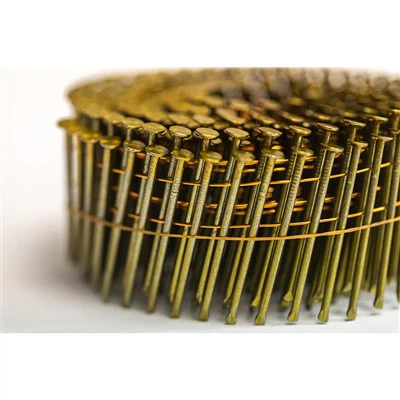
Let's start by getting to know smooth coil nails a bit better. Smooth coil nails are widely used in the construction and woodworking industries. They come in different shapes and sizes, each designed for specific applications. For example, we've got Non-standard Smooth Coil Nails, which are perfect for those unique projects where standard nails just won't cut it. Then there are the Coil Nail Yellow Coated Smooth Shank, known for their corrosion resistance, and the Chisel Point Smooth Coil Nails, which are great for quick and easy penetration.
Now, when it comes to the maximum penetration depth of smooth coil nails, there are several factors at play. The first one is the nail's size and gauge. Generally speaking, longer nails can penetrate deeper than shorter ones. A thicker gauge nail will also have more strength and can potentially penetrate deeper. For instance, a 3 - inch smooth coil nail will usually penetrate deeper than a 2 - inch one in the same material.
The type of material the nail is being driven into is another crucial factor. Softwoods like pine are much easier to penetrate than hardwoods like oak. In softwoods, smooth coil nails can penetrate relatively deeply with less force. You might be able to drive a 3 - inch nail almost all the way in with a standard nail gun. But when it comes to hardwoods, the maximum penetration depth might be reduced. The density of the wood makes it more resistant to the nail, and you may need a more powerful nail gun or a different type of nail point to achieve a greater depth.
The power of the nail gun is also significant. A high - powered nail gun can drive nails deeper than a low - powered one. If you're using a pneumatic nail gun, the air pressure setting can affect the penetration depth. Higher air pressure means more force behind the nail, allowing it to penetrate deeper. However, you've got to be careful not to set the pressure too high, as it could cause the nail to split the wood or damage the surface.
Let's take a closer look at some real - world scenarios. In a typical framing project using softwood studs, a 2.5 - inch smooth coil nail can usually penetrate about 2 inches into the wood. This is enough to provide a strong hold for the framing structure. But if you're working on a deck made of hardwood, like teak, you might find that a 3 - inch nail only penetrates about 1.5 inches. This is because the hardwood is much denser and more resistant to the nail.
To get the maximum penetration depth, it's important to prepare the material properly. If you're working with wood, pre - drilling a pilot hole can sometimes help. A pilot hole reduces the resistance the nail encounters as it's being driven in, allowing it to penetrate deeper. However, you need to make sure the pilot hole is the right size. If it's too large, the nail won't have a good grip; if it's too small, it won't reduce the resistance enough.
Another thing to consider is the point style of the nail. Chisel point nails, as I mentioned earlier, are designed to cut through the material more easily. They can often penetrate deeper than nails with a blunt point. The sharp edge of the chisel point helps to break through the fibers of the material, reducing the force needed to drive the nail in.
In some cases, you might be dealing with materials other than wood, like concrete or metal. When driving smooth coil nails into concrete, you'll need a special type of nail gun and nails designed for concrete applications. These nails are usually made of stronger materials and have a different point style to penetrate the hard surface. The maximum penetration depth in concrete will depend on the strength of the nail and the power of the nail gun, but it's generally much less than in wood.

When it comes to metal, smooth coil nails are not typically the first choice. Metal is very hard and requires specialized fasteners like screws or rivets. However, if you're using a nail gun to attach a thin metal sheet to a wooden surface, a smooth coil nail can work. The penetration depth will depend on the thickness of the metal and the type of wood beneath it.
So, to sum it up, there's no one - size - fits - all answer to the question of the maximum penetration depth of smooth coil nails. It depends on the nail's size, gauge, point style, the type of material it's being driven into, and the power of the nail gun. By understanding these factors, you can make more informed decisions when choosing the right nails for your project.
If you're in the market for smooth coil nails for your next project, whether it's a small DIY job or a large - scale construction project, I'm here to help. I've got a wide range of smooth coil nails to meet your needs. Just reach out, and we can have a chat about which nails are best for you. Let's get your project off to a great start with the right smooth coil nails!
References
- Wood Handbook: Wood as an Engineering Material, USDA Forest Service
- Construction Fasteners and Tools Manual, McGraw - Hill