

As a threaded nail supplier, I often receive inquiries from customers about the technical aspects of our products. One question that frequently comes up is, "What is the coefficient of friction of a threaded nail?" This is a crucial topic as it directly impacts the performance and application of threaded nails. In this blog post, I'll delve into the concept of the coefficient of friction for threaded nails, explain its significance, and provide some insights based on our experience in the industry.
Understanding the Coefficient of Friction
The coefficient of friction is a dimensionless number that represents the ratio of the force of friction between two surfaces to the normal force pressing the two surfaces together. In the context of threaded nails, it describes how much resistance the nail encounters as it is driven into a material, such as wood or concrete. A higher coefficient of friction means more resistance, which can be both an advantage and a disadvantage depending on the application.
There are two main types of coefficients of friction: static and kinetic. The static coefficient of friction applies when the nail is at rest and an external force is trying to start its movement. Once the nail begins to move, the kinetic coefficient of friction comes into play. Generally, the static coefficient of friction is higher than the kinetic one.
Factors Affecting the Coefficient of Friction of Threaded Nails
1. Thread Design
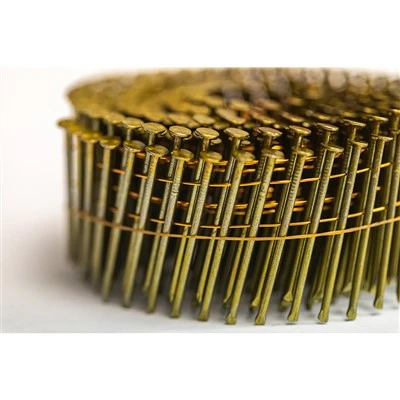
The design of the threads on a nail has a significant impact on its coefficient of friction. Threads with a larger pitch (the distance between adjacent threads) will typically have a lower coefficient of friction compared to those with a smaller pitch. This is because a larger pitch means less surface area in contact with the material, resulting in less frictional resistance. Additionally, the shape of the threads, such as square, triangular, or rounded, can also affect the coefficient of friction. For example, triangular threads may provide more biting action and thus a higher coefficient of friction.

2. Surface Finish
The surface finish of the nail can greatly influence the coefficient of friction. A smooth surface finish will generally have a lower coefficient of friction compared to a rough or textured surface. However, a very smooth surface may reduce the nail's holding power over time as it can more easily slip out of the material. On the other hand, a rough surface finish can increase the coefficient of friction but may also make it more difficult to drive the nail into the material.
3. Material of the Nail and the Substrate
The materials of both the nail and the substrate (the material into which the nail is driven) play a crucial role. Different metals used for nails, such as steel, aluminum, or brass, have different surface properties and hardness, which can affect the coefficient of friction. Similarly, the type of wood, concrete, or other materials used as the substrate will also impact the frictional resistance. For example, driving a threaded nail into a dense hardwood will result in a higher coefficient of friction compared to a softwood.
4. Lubrication
The presence of lubrication can significantly reduce the coefficient of friction. In some applications, nails may be coated with a lubricant to make them easier to drive. However, this can also affect the long - term holding power of the nail, as the lubricant may reduce the frictional forces that keep the nail in place over time.
Significance of the Coefficient of Friction in Threaded Nail Applications
1. Holding Power
The coefficient of friction is directly related to the holding power of the nail. A higher coefficient of friction means that the nail is more likely to stay in place once it is driven into the material. This is especially important in applications where the nail needs to support a load or resist movement, such as in construction or furniture making. For example, in a wooden structure, a threaded nail with a high coefficient of friction will provide better structural integrity by preventing the components from coming apart.
2. Ease of Installation
On the other hand, a very high coefficient of friction can make it difficult to install the nail. If the frictional resistance is too high, it may require more force to drive the nail, which can lead to issues such as bending or breaking of the nail. Therefore, finding the right balance between holding power and ease of installation is crucial. Our Coil Nails Yellow Coated Screw Shank are designed to offer an optimal balance, with a thread design and surface finish that allows for relatively easy installation while still providing excellent holding power.
3. Durability
The coefficient of friction also affects the durability of the nail. A nail with a proper coefficient of friction is less likely to loosen over time due to vibrations or other external forces. This is important in applications where the nail is exposed to long - term stress, such as in outdoor structures or machinery.
Measuring the Coefficient of Friction of Threaded Nails
Measuring the coefficient of friction of threaded nails is a complex process that typically involves specialized equipment. One common method is to use a tensile testing machine to measure the force required to pull a nail out of a material. By measuring the normal force (the force pressing the nail into the material) and the frictional force (the force required to pull the nail out), the coefficient of friction can be calculated using the formula:
[ \mu=\frac{F_f}{F_n} ]
where (\mu) is the coefficient of friction, (F_f) is the frictional force, and (F_n) is the normal force.
However, it's important to note that the coefficient of friction can vary depending on the specific testing conditions, such as the type of testing equipment, the rate of loading, and the condition of the nail and the material.
Our Product Range and Coefficient of Friction
At our company, we offer a wide range of threaded nails, including 3 1/2 Coil Nails and 3 Coil Nails. We carefully design and manufacture our nails to ensure that they have an appropriate coefficient of friction for various applications. Our research and development team continuously works on optimizing the thread design, surface finish, and material selection to provide nails with the best combination of holding power, ease of installation, and durability.
For example, our yellow - coated screw - shank coil nails are designed with a unique thread pattern that provides a high coefficient of friction for excellent holding power. The yellow coating not only provides corrosion resistance but also helps to reduce the frictional resistance during installation, making it easier to drive the nails into the material.
Conclusion
The coefficient of friction of a threaded nail is a critical factor that affects its performance, holding power, and ease of installation. As a threaded nail supplier, we understand the importance of providing nails with the right coefficient of friction for different applications. Our commitment to quality and innovation ensures that our customers receive products that meet their specific needs.
If you are in the market for high - quality threaded nails and want to learn more about how the coefficient of friction can impact your project, we encourage you to contact us. Our team of experts is ready to assist you in selecting the right product for your application and answer any questions you may have. Whether you are a contractor, a DIY enthusiast, or a manufacturer, we are here to provide you with the best solutions for your fastening needs.
References
- Bowden, F. P., & Tabor, D. (1950). The Friction and Lubrication of Solids. Oxford University Press.
- Holman, J. P. (2001). Experimental Methods for Engineers. McGraw - Hill.
- Timoshenko, S. P., & Goodier, J. N. (1970). Theory of Elasticity. McGraw - Hill.